Total Pageviews

Wednesday, 15 May 2019

Crowned by Burger King, meat replacement company Impossible Foods raises $300 million

After being crowned by Burger King as the first meat replacement patty to roll out nationally with one of the largest fast food chains, Impossible Foods has raised $300 million in capital.

The financing brings the company’s total equity raise to $750 million — and provides a sizable pool of funds to draw from as it continues to compete with its newly publicly traded rival, Beyond Meat.

Both companies are looking to provide plant-based replacements for animal proteins, but while Beyond Meat has focused on consumers in the grocery store, Impossible Foods has focused on restaurants and business-to-business sales.

That focus paid off earlier this year with the announcement of the Impossible Whopper, and its subsequent nationwide rollout only a month later.

The Impossible Burger is now sold in more than 7,000 restaurants in the U.S. and Europe and has been a top-selling item and a driver of new foot traffic, according to the company. However, since it’s actually driving new foot traffic to restaurants, the product’s impact as a meat replacement is arguable. There’s no data from the company on whether people are actually buying less meat, or whether new customers are entering stores.

Investors don’t seem to mind. And given the success of Beyond Meat’s public offering earlier this year, Impossible Foods has a benchmark it can reference to illustrate the appetite institutional investors have for meat replacement companies.

Indeed, even corporate America has taken notice, with Tyson Foods hatching plans to bring its own meat replacement product to market in the coming years.

Previous investors Temasek, the investment arm of the Singaporean government, and Horizons Ventures, the personal venture fund of Hong Kong multi-billionaire Li Ka-shing, led the new financing, which also included a host of celebrity investors.

Jay Brown, Kirk Cousins, Paul George, Jay-Z, Trevor Noah, Alexis Ohanian, Kal Penn, Katy Perry Questlove, Ruby Rose, Phil Rosenthal, Jaden Smith, Serena Williams, will.i.am and Zedd also joined the financing round, making Impossible Foods officially the coolest cap table I’ve ever seen (no offense to Beyond Meat backer Leonardo DiCaprio).

Institutional investors like Khosla Ventures, Bill Gates, Google Ventures, UBS, Viking Global Investors, Sailing Capital and Open Philanthropy Project also back the company.

The presence of Impossible Foods’ Asian investors point to the hunger for protein replacements on the continent where the quality of meat is an issue and rising demand is putting increasing pressure on companies looking to feed the continent’s newly wealthy consumers more high-quality protein.

There’s a compelling reason to hope that both companies succeed in their mission to reduce demand for animal protein around the world. Animal husbandry and industrial farming contribute heavily to rising greenhouse gas emissions (which is kind of a huge problem).

And it seems that the strategy is working in Asia. Sales across the continent are rising, according to the company, in restaurants across Hong Kong, Singapore and Macau.

Founded in 2011 by former pediatrician and Stanford biochemistry professor Dr. Patrick O. Brown, Impossible Foods’ plant-based burger may be the second greatest invention by a Doc Brown since the ’80s.

Impossible Foods is also hiring extensively in Oakland, Calif., where the company has its largest plant. It has already added to its executive team since the new funding, bringing on Sheetal Shah, a former chief operations officer at Verifone, to oversee the company’s manufacturing, supply chain and logistics.


via Startups – TechCrunch https://tcrn.ch/2HjSL1J

Wyze Sense review: This $20 sensor system is a steal for security DIYers

This starter kit of two contact sensors and one motion sensor extends the capabilities of Wyze's affordable security cameras.

from Macworld http://bit.ly/2Q4g03Q
via IFTTT

Tineco Pure One S12 review: This smart cordless vacuum detects dust

The Pure One S12 adapts its suction power to the amount of dust on your floors and furniture.

from Macworld http://bit.ly/2vSuRoB
via IFTTT

The next-gen Google Assistant is taking the privacy fight right to Siri—and it just might win

SpaceX kicks off its space-based internet service tomorrow with 60-satellite Starlink launch

As wild as it sounds, the race is on to build a functioning space internet — and SpaceX is taking its biggest step yet with the launch of 60 (!) satellites tomorrow that will form the first wave of its Starlink constellation. It’s a hugely important and incredibly complex launch for the company — and should be well worth launching.

A Falcon 9 loaded to the gills with the flat Starlink test satellites (they’re “production design” but not final hardware) is vertical at launchpad 40 in Cape Canaveral. It has completed its static fire test and should have a window for launch tomorrow, weather permitting.

Building satellite constellations hundreds or thousands strong is seen by several major companies and investors as the next major phase of connectivity — though it will take years and billions of dollars to do so.

OneWeb, perhaps SpaceX’s biggest competitor in this area, just secured $1.25 billion in funding after launching the first six satellites in March (of a planned 650). Jeff Bezos has announced that Amazon will join the fray with the proposed 3,236-satellite Project Kuiper. Ubiquitilink has a totally different approach. And plenty of others are taking on smaller segments, like lower-cost or domain-specific networks.

Needless to say it’s an exciting sector, but today’s launch is a particularly interesting one because it is so consequential for SpaceX. If this doesn’t go well, it could set Starlink’s plans back long enough to give competitors an edge.

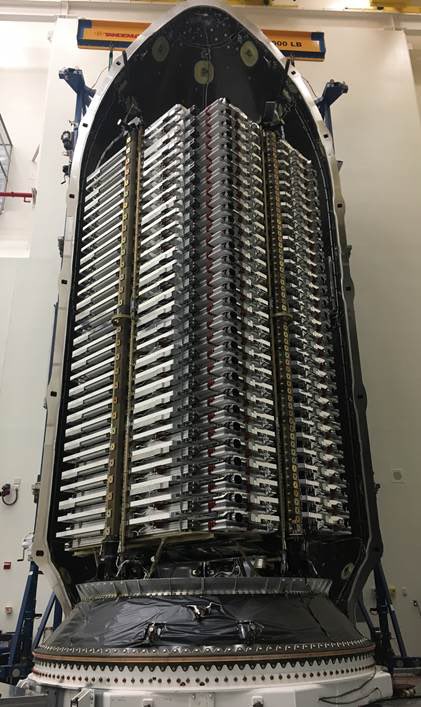
The satellites stacked inside the Falcon 9 payload fairing. “Tight fit,” pointed out CEO Elon Musk.

SpaceX hasn’t explained exactly how the 60 satellites will be distributed to their respective orbits, but founder and CEO Elon Musk did note on Twitter that there’s “no dispenser.” Of course there must be some kind of dispenser — these things aren’t going to just jump off of their own accord. They’re stuffed in there like kernels on a corncob, and likely each have a little spring that sends them out at a set velocity.

A pair of prototype satellites, Tintin-A and B, have been in orbit since early last year, and have no doubt furnished a great deal of useful information to the Starlink program. But the 60 aboard tomorrow’s launch aren’t quite final hardware. Although Musk noted that they are “production design,” COO Gwynne Shotwell has said that they are still test models.

“This next batch of satellites will really be a demonstration set for us to see the deployment scheme and start putting our network together,” she said at the Satellite 2019 conference in Washington, D.C. — they reportedly lack inter-satellite links but are otherwise functional. I’ve asked SpaceX for more information on this.

It makes sense: If you’re planning to put thousands (perhaps as many as 12,000 eventually) of satellites into orbit, you’ll need to test at scale and with production hardware.

And for those worried about the possibility of overpopulation in orbit — it’s absolutely something to consider, but many of these satellites will be flying at extremely low altitudes; at 550 kilometers up, these tiny satellites will naturally de-orbit in a handful of years. Even OneWeb’s, at 1,100 km, aren’t that high up — geosynchronous satellites are above 35,000 km. That doesn’t mean there’s no risk at all, but it does mean failed or abandoned satellites won’t stick around for long.

Just don’t expect to boot up your Starlink connection any time soon. It would take a minimum of six more launches like this one — a total of 420, a happy coincidence for Musk — to provide “minor” coverage. This would likely only be for testing as well, not commercial service. That would need 12 more launches, and dozens more to bring it to the point where it can compete with terrestrial broadband.

Even if it will take years to pull off, that is the plan. And by that time others will have spun up their operations as well. It’s an exciting time for space and for connectivity.

No launch time has been set as of this writing, so takeoff is just planned for Wednesday the 15th at present. As there’s no need to synchronize the launch with the movement of any particular celestial body, T-0 should be fairly flexible and SpaceX will likely just wait for the best weather and visibility. Delays are always a possibility, though, so don’t be surprised if this is pushed out to later in the week.

As always you’ll be able to watch the launch at the SpaceX website, but I’ll update this post with the live video link as soon as it’s available.


from Gadgets – TechCrunch https://tcrn.ch/2JFVt4c
via IFTTT

WhatsApp urges users to update app after major vulnerability discovered

WhatsApp calls offer attackers a way in to others' mobile devices

WhatsApp is urging users everywhere to update their apps after the discovery of a major vulnerability that lets attackers read messages on targeted devices. A fix was released Friday.

.. Continue Reading WhatsApp urges users to update app after major vulnerability discovered

Category: Mobile Technology

Tags:

from New Atlas (Gizmag) http://bit.ly/2LG9amA
via IFTTT

Study links spikes in oxygen levels with bursts of evolution

A new study adds support to the theory that spikes in oxygen levels helped make conditions ...

Life on Earth may have begun billions of years ago with a quiet, single-celled whimper, but it really arrived with a bang about 540 million years ago. Within a relatively short period of time, life burst forth into an incredible diversity of forms, in an event that has since come to be known as the Cambrian explosion. Now, an international team of scientists has found clues to what may have caused that – spikes in oxygen levels.

.. Continue Reading Study links spikes in oxygen levels with bursts of evolution

Category: Science

Tags:

from New Atlas (Gizmag) http://bit.ly/2Hjq4mJ
via IFTTT