Total Pageviews

Showing posts with label Gadgets – TechCrunch. Show all posts

Tuesday, 10 November 2020

Sony prepares to enter the drone game with Airpeak

Sony has announced that it is entering the drone market with a new brand called Airpeak, though the specifics of the drone itself are left something of a mystery. It plans to launch the project next spring.

The barebones announcement says only that Sony has been inspired by the “recent proliferation” of drones and the changes they have caused in both the industrial and creative sectors.

Airpeak will focus on multiple industries as well, though it has its work cut out for it if it intends to go up against DJI, which has become the first choice in the consumer UAV sector.

Sony describes the drone as being developed within “the field of AI robotics,” which, along with the aim to enable drone use where it was previously difficult to do so, suggests Sony plans to integrate a fair amount of intelligence into the drones’ systems.

Small UAVs have gotten smarter and smarter, able now to avoid obstacles, recognize other flying objects, and navigate between buildings without any intervention from their human operators. But many of these capabilities are still essentially theoretical rather than widely deployed.

Beyond the name, general flavor of the project, and a render of what is almost certainly a rotor, that is the sum total of what we know about Sony’s new project. Expect more to be posted to the official website in time.


from Gadgets – TechCrunch https://ift.tt/3eFLEAW
via IFTTT

Friday, 3 July 2020

Festo’s latest biomimetic robots are a flying feathered bird and ball-bottomed helper arm

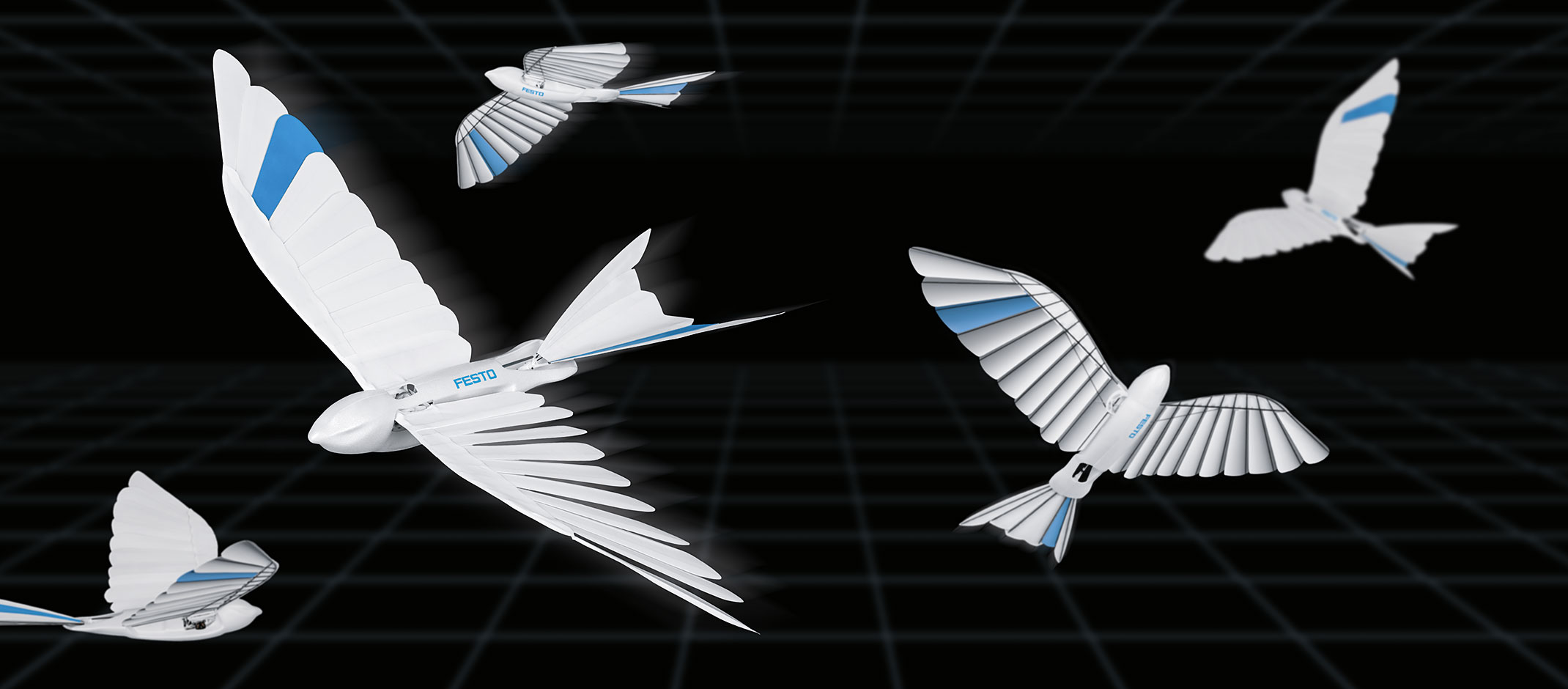
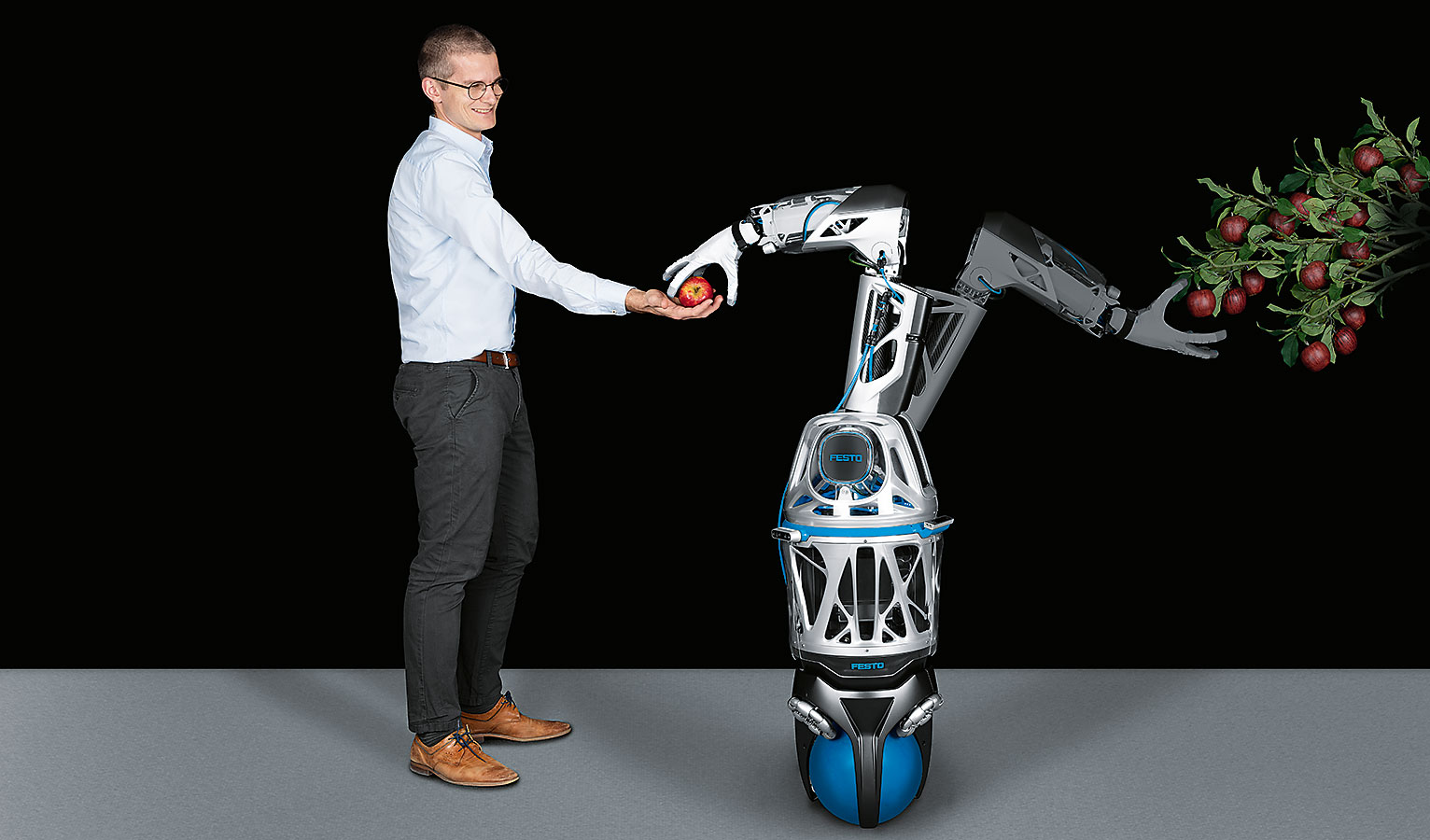
You could be excused for thinking that German robotics company Festo does nothing but put together fabulous prototype robots built to resemble kangaroos, jellyfish, and other living things. They do in fact actually make real industrial robots, but it’s hard not to marvel at their biomimetic experiments; Case in point, the feathered BionicSwift and absurd BionicMobileAssistant motile arm.

Festo already has a flying bird robot — I wrote about it almost 10 years ago. They even made a flying bat as a follow-up. But the BionicSwift is more impressive than both because, in an effort to more closely resemble its avian inspiration, it flies using artificial feathers.

Image Credits: Festo

“The individual lamellae [i.e. feathers] are made of an ultralight, flexible but very robust foam and lie on top of each other like shingles. Connected to a carbon quill, they are attached to the actual hand and arm wings as in the natural model,” Festo writes in its description of the robot.

The articulating lamellae allow the wing to work like a bird’s, forming a powerful scoop on the downstroke to push against the air, but separating on the upstroke to produce less resistance. Everything is controlled on-board, including the indoor positioning system that the bird was ostensibly built to demonstrate. Flocks of BionicSwifts can fly in close quarters and avoid each other using an ultra wideband setup.

Festo’s BionicMobileAssistant seems like it would be more practical, and in a way it is, but not by much. The robot is basically an arm emerging from a wheeled base — or rather a balled one. The spherical bottom is driven by three “omniwheels,” letting it move easily in any direction while minimizing its footprint.

The hand is a showcase of modern robotic gripper design, with all kinds of state of the art tech packed in there — but the result is less than the sum of its parts. What makes a robotic hand good these days is less that it has a hundred sensors in the palm and fingers and huge motility for its thumb, but rather intelligence about what it is gripping. An unadorned pincer may be a better “hand” than one that looks like the real thing because of the software that backs it up.

Not to mention the spherical movement strategy makes for something of an unstable base. It’s telling that the robot is transporting scarves and not plates of food or parts.

Of course, it’s silly to criticize such a machine, which is aspirational rather than practical. But it’s important to understand that these fascinating creations from Festo are hints at a possible future more than anything.


from Gadgets – TechCrunch https://ift.tt/3ilF5Fb
via IFTTT

Monday, 22 June 2020

Watch Apple’s WWDC keynote live right here

Apple is holding a keynote today on the first day of its developer conference, and the company is expected to talk about a ton of software updates. WWDC is a virtual event this year, but you can expect the same amount of news, in a different format. At 10 AM PT (1 PM in New York, 6 PM in London, 7 PM in Paris), you’ll be able to watch the event as the company is streaming it live.

Rumor has it that the company plans to unveil new versions of its operating systems. Get ready for iOS 14 and its sibling iPadOS 14, a new version of macOS, some updates for watchOS and tvOS as well.

But the most interesting rumor of the year is that Apple could announce a major change for the Mac. The company could start using its own in-house ARM systems on a chip instead of Intel’s processors. It would have a ton of consequences for third-party apps running on your Mac as well as Mac hardware in general. Imagine a MacBook with a battery that lasts as long as what you get from an iPad. There could be some more hardware news, such as a new design for the iMac or some Tile-style hardware trackers.

You can watch the live stream directly on this page as Apple is streaming its conference on YouTube.

If you have an Apple TV, you can download the Apple Events app in the App Store. It lets you stream today’s event and rewatch old ones. The app icon was updated a few days ago for the event.

And if you don’t have an Apple TV and don’t want to use YouTube, the company also lets you live-stream the event from the Apple Events section on its website. This video feed now works in all major browsers — Safari, Microsoft Edge, Google Chrome and Mozilla Firefox.

Of course, you also can read TechCrunch’s live blog if you don’t want to stop everything and watch a video.


from Gadgets – TechCrunch https://ift.tt/3hMA6wJ
via IFTTT

Friday, 1 May 2020

The ‘PuffPacket’ could help researchers learn when, how and why people vape

Vaping is a controversial habit: it certainly has its downsides, but anecdotally it’s a fantastic smoking cessation aid. The thing is, until behavioral scientists know a bit more about who does it, when, how much and other details, its use will continue to be something of a mystery. That’s where the PuffPacket comes in.

Designed by Cornell engineers, the PuffPacket is a small device that attaches to e-cigarettes (or vape pens, or whatever you call yours) and precisely measures their use, sharing that information with a smartphone app for the user, and potentially researchers, to review later.

Some vaping devices are already set up with something like this, to tell a user when the cartridge is running low or a certain limit has been reached. But generally when vaping habits are studied, they rely on self-report data, not proprietary apps.

“The lack of continuous and objective understanding of vaping behaviors led us to develop PuffPacket to enable proper measurement, monitoring, tracking and recording of e-cigarette use, as opposed to inferring it from location and activity data, or self-reports,” said PhD student Alexander Adams, who led the creation of the device, in a Cornell news release.

The device fits a number of e-cigarette types, fitting between the mouthpiece and the heating element. It sits idle until the user breathes in, which activates the e-cigarette’s circuits, and the PuffPacket’s as well. By paying attention to the voltage, it can tell how much liquid is being vaporized, as well as simpler measurements like the duration and timing of the inhalation.

An example using real data of how location and activity could be correlated with vaping

This data is sent to the smartphone app via Bluetooth, where it is cross-referenced with other information, like location, motion and other metadata. This may lead to identifiable patterns, like that someone vapes frequently when they walk in the morning but not the afternoon, or after coffee but not meals, or far more at the bar than at home — that sort of thing. Perhaps even (with the proper permissions) it could track use of certain apps — Instagram and vape? Post-game puff?

Some of these might be obvious, others not so much — but either way, it helps to have them backed up by real data rather than asking a person to estimate their own usage. They may not know, understand or wish to admit their own habits.

“Getting these correlations between time of day, place and activity is important for understanding addiction. Research has shown that if you can keep people away from the paths of their normal habits, it can disrupt them,” said Adams.

No one is expecting people to voluntarily stick these things on their vape pens and share their info, but the design — which is being released as open source — could be used by researchers performing more formal studies. You can read the paper describing PuffPacket here.


from Gadgets – TechCrunch https://ift.tt/3d1Zyep
via IFTTT

Thursday, 12 March 2020

Desperate to exit, a $10B price tag for Magic Leap is crazy

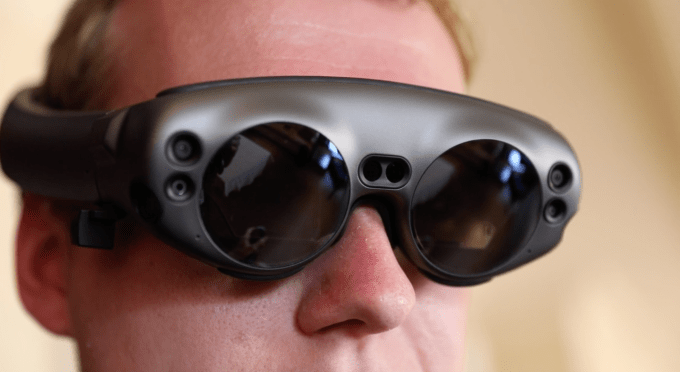
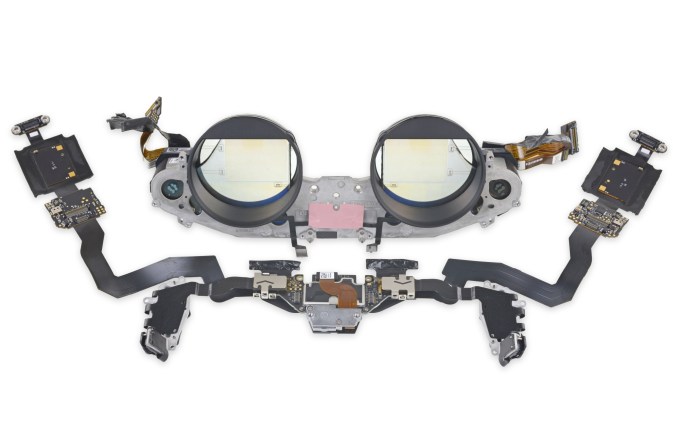
Augmented reality headset maker Magic Leap has struggled with the laws of physics and failed to get to market. Now it’s seeking an acquirer, but talks with Facebook and medical goods giant Johnson & Johnson led nowhere according to a new report from Bloomberg’s Ed Hammond.

After raising over $2 billion and being valued between $6 billion and $8 billion back when it still had momentum, Hammond writes that “Magic Leap could fetch more than $10 billion if it pursues a sale” according to his sources. That price seems ridiculous. It’s the kind of number a prideful company might strategically leak in hopes of drumming up acquisition interest, even at a lower price.

Startups have been getting their valuations chopped when they go public. The whole economy is hurting due to coronavirus. Augmented Reality seems less interesting than virtual reality with people avoiding public places. Getting people to strap used AR hardware to their face for demos seems like a tough sell for the forseeable future.

No one has proven a killer consumer use case for augmented reality eyewear that warrants an expensive and awkward-to-wear gadget. Our phones can already deliver plenty of AR’s value while letting you take selfies and do video chat that headsets can’t. My experiences with Magic Leap at Sundance Film Festival last year were laughably disappointing, with its clunky hardware, ghostly projections, and narrow field of view.

Apple and Facebook are throwing the enduring profits of iPhones and the News Feed into building a better consumer headset. Snapchat has built intermediary glasses since CEO Evan Spiegel thinks it will be a decade before AR headsets see mainstream adoption. AR rivals like Microsoft have better enterprise experience, connections, and distribution. Enterprise AR startup Daqri crashed and burned.

Magic Leap’s CEO said he wanted to sell 1 million of its $2300 headset in its first year, then projected it would sell 100,000 headsets, but only moved 6,000 in the first six months, according to a daming report from The Information’s Alex Heath. Alphabet CEO Sundar Pichai left Magic Leap’s board despite Google leading a $514 million funding round for the startup in 2014. Business Insider’s Steven Tweedie and Kevin Webb revealed CFO Scott Henry and SVP of creative strategy John Gaeta bailed in November. The company suffered dozens of layoffs. It lost a $500 million contract to Microsoft last year. The CEOs of Apple, Google, and Facebook visited Magic Leap headquarters in 2016 to explore an acquisition deal, but no offers emerged.

Is AR eyewear part of the future? Almost surely. And is this startup valuable? Certainly somewhat. But Magic Leap may prove to be too little too early for a company burning cash by the hundreds of millions in a market newly fixated on efficiency. A $10 billion price tag would require one of the world’s biggest corporations to believe Magic Leap has irreplicable talent and technology that will earn them a fortune in the somewhat distant future.

The fact that Facebook, which does not shy from tall acquisition prices, didn’t want to buy Magic Leap is telling. This isn’t a product with hundreds of millions of users or fast-ramping revenue. It’s a gamble on vision and timing that looks to be coming up snake eyes. It’s unclear when the startup would ever be able to deliver on its renderings of flying whales and living room dinosaurs in a form factor people actually want to wear.


One of Magic Leap’s early renderings of what it could supposedly do

With all their money and plenty of time before widespread demand for AR headsets materializes, potential acquirers could likely hire away the talent and make up the development time in cheaper ways than buying Magic Leap. If someone acquires them for too much, it feels like a write-off waiting to happen.


from Gadgets – TechCrunch https://ift.tt/2Q8Qmfj
via IFTTT

Tuesday, 25 February 2020

Forensic Architecture redeploys surveillance state tech to combat state-sponsored violence

The specter of constant surveillance hangs over all of us in ways we don’t even fully understand, but it is also possible to turn the tools of the watchers against them. Forensic Architecture is exhibiting several long-term projects at the Museum of Art and Design in Miami that use the omnipresence of technology as a way to expose crimes and violence by oppressive states.

Over seven years Eyal Weizman and his team have performed dozens of investigations into instances of state-sponsored violence, from drone strikes to police brutality. Often these events are minimized at all levels by the state actors involved, denied or no-commented until the media cycle moves on. But sometimes technology provides ways to prove a crime was committed and occasionally even cause the perpetrator to admit it — hoisted by their own electronic petard.

Sometimes this is actual state-deployed kit, like body cameras or public records, but it also uses private information co-opted by state authorities to track individuals, like digital metadata from messages and location services.

For instance, when Chicago police shot and killed Harith Augustus in 2018, the department released some footage of the incident, saying that it “speaks for itself.” But Forensic Architecture’s close inspection of the body cam footage and cross reference with other materials makes it obvious that the police violated numerous rules (including in the operation of the body cams) in their interaction with him, escalating the situation and ultimately killing a man who by all indications — except the official account — was attempting to comply. It also helped additional footage see the light which was either mistakenly or deliberately left out of a FOIA release.

In another situation, a trio of Turkish migrants seeking asylum in Greece were shown, by analysis of their WhatsApp messages, images, and location and time stamps, to have entered Greece and been detained by Greek authorities before being “pushed back” by unidentified masked escorts, having been afforded no legal recourse to asylum processes or the like. This is one example of several recently that appear to be private actors working in concert with the state to deprive people of their rights.

Situated testimony for survivors

I spoke with Weizman before the opening of this exhibition in Miami, where some of the latest investigations are being shown off. (Shortly after our interview he would be denied entry to the U.S. to attend the opening, with a border agent explaining that this denial was algorithmically determined; We’ll come back to this.)

The original motive for creating Forensic Architecture, he explained, was to elicit testimony from those who had experienced state violence.

“We started using this technique when in 2013 we met a drone survivor, a German woman who had survived a drone strike in Pakistan that killed several relatives of hers,” Weizman explained. “She has wanted to deliver testimony in a trial regarding the drone strike, but like many survivors her memory was affected by the trauma she has experienced. The memory of the event was scattered, it had lacunae and repetitions, as you often have with trauma. And her condition is like many who have to speak out in human rights work: The closer you get to the core of the testimony, the description of the event itself, the more it escapes you.”

The approach they took to help this woman, and later many others, jog her own memory, was something called “situated testimony.” Essentially it amounts to exposing the person to media from the experience, allowing them to “situate” themselves in that moment. This is not without its own risks.

“Of course you must have the appropriate trauma professionals present,” Weizman said. “We only bring people who are willing to participate and perform the experience of being again at the scene as it happened. Sometimes details that would not occur to someone to be important come out.”
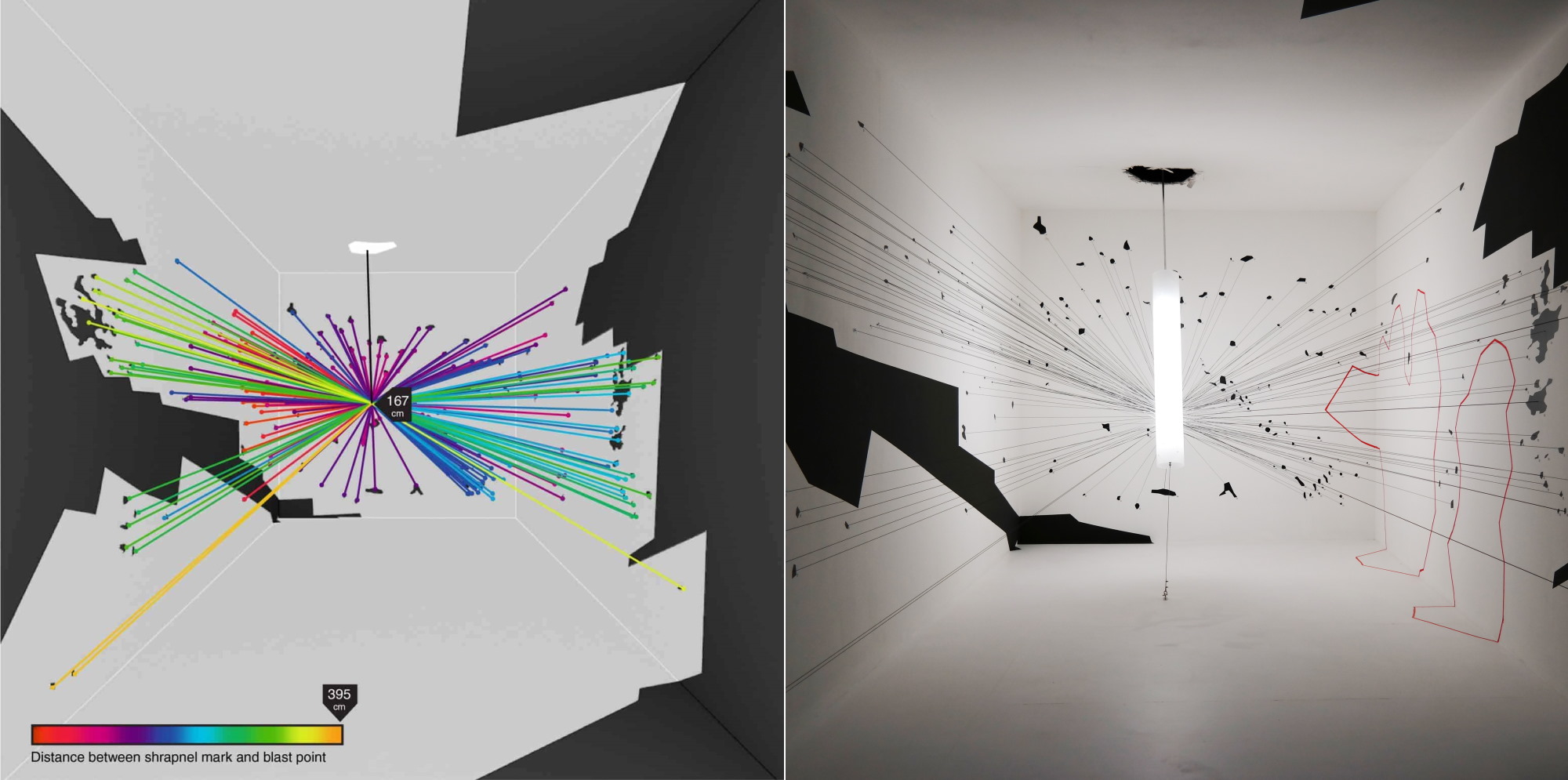
A digital reconstruction of a drone strike’s explosion was recreated physically for another exhibition.

But it’s surprising how effective it can be, he explained. One case exposed American involvement hitherto undisclosed.

“We were researching a Cameroon special forces detention center, torture and death in custody occurred, for Amnesty International,” he explained. “We asked detainees to describe to us simply what was outside the window. How many trees, or what else they could see.” Such testimony could help place their exact location and orientation in the building and lead to more evidence, such as cameras across the street facing that room.

“And sitting in a room based on a satellite image of the area, one told us: ‘yes, there were two trees, and one was over by the fence where the American soldiers were jogging.’ We said, ‘wait, what, can you repeat that?’ They had been interviewed many times and never mentioned American soldiers,” Weizman recalled. “When we heard there were American personnel, we found Facebook posts from service personnel who were there, and were able to force the transfer of prisoners there to another prison.”

Weizman noted that the organization only goes where help is requested, and does not pursue what might be called private injustices, as opposed to public.

“We require an invitation, to be invited into this by communities that invite state violence. We’re not a forensic agency, we’re a counter-forensic agency. We only investigate crimes by state authorities.”

Using virtual reality: “Unparalleled. It’s almost tactile.”

In the latest of these investigations, being exhibited for the first time at MOAD, the team used virtual reality for the first time in their situated testimony work. While VR has proven to be somewhat less compelling than most would like on the entertainment front, it turns out to work quite well in this context.

“We worked with an Israeli whistleblower soldier regarding testimony of violence he committed against Palestinians,” Weizman said. “It has been denied by the Israeli prime minister and others, but we have been able to find Palestinian witnesses to that case, and put them in VR so we could cross reference them. we had victim and perpetrator testifying to the same crime in the same space, and their testimonies can be overlaid on each other.”
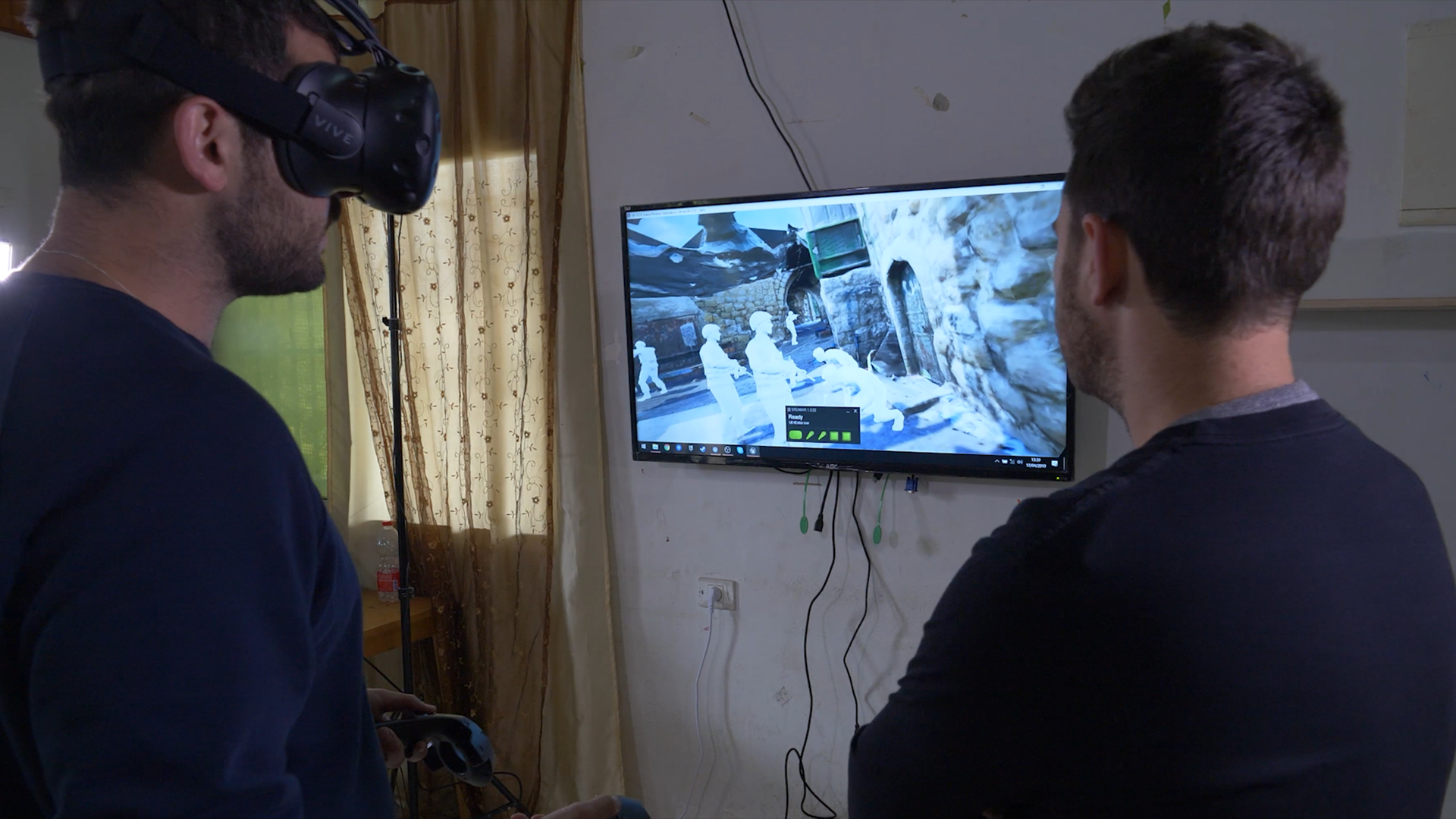
Dean Issacharoff – the soldier accused by Israel of giving false testimony – describes the moment he illegally beat a Palestinian civilian. (Caption and image courtesy of Forensic Architecture)

One thing about VR is that the sense of space is very real; If the environment is built accurately, things like sight-lines and positional audio can be extremely true to life. If someone says they saw the event occur here, but the state says it was here, and a camera this far away saw it at this angle… these incomplete accounts can be added together to form something more factual, and assembled into a virtual environment.

“That project is the first use of VR interviews we have done —  it’s still in a very experimental stage. But it didn’t involve fatalities, so the level of trauma was a bit more controlled,” Weizman explained. “We have learned that the level and precision we can arrive at in reconstructing and incident is unparalleled. It’s almost tactile; You can walk through the space, you can see every object: guns, cars, civilians. And you can populate it until the witness is satisfied that this is what they experienced. I think this is a first, definitely in forensic terms, as far as uses of VR.”
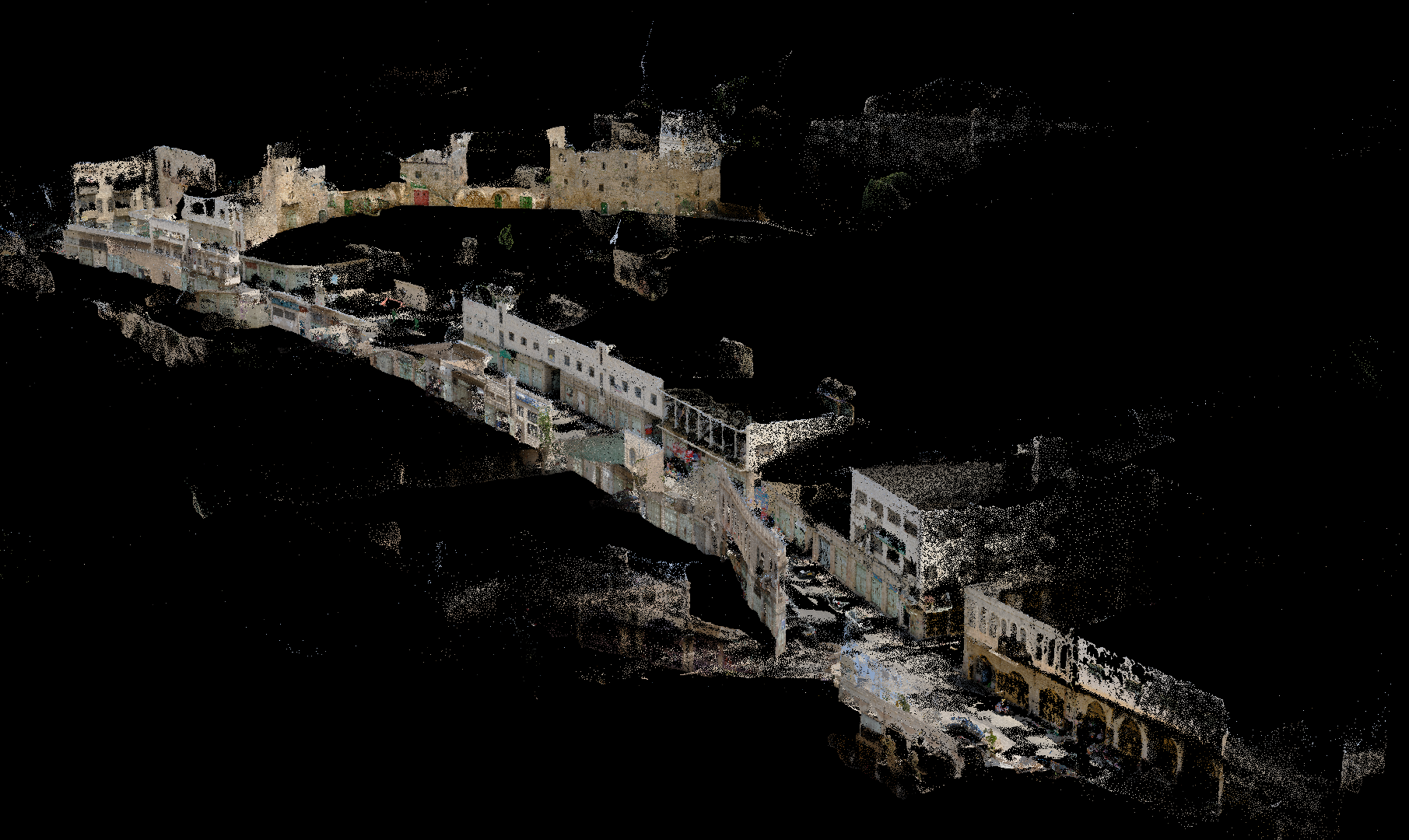
A photogrammetry-based reconstruction of the area of Hebron where the incident took place.

In video of the situated testimony, you can see witnesses describing locations more exactly than they likely or even possibly could have without the virtual reconstruction. “I stood with the men at exactly that point,” says one, gesturing towards an object he recognized, then pointing upwards: “There were soldiers on the roof of this building, where the writing is.”

Of course it is not the digital recreation itself that forces the hand of those involved, but the incontrovertible facts it exposes. No one would ever have know that the U.S. had a presence at that detainment facility, and the country had no reason to say it did. The testimony wouldn’t even have been enough, except that it put the investigators onto a line of inquiry that produced data. And in the case of the Israeli whistleblower, the situated testimony defies official accounts that the organization he represented had lied about the incident.

Avoiding “product placement” and tech incursion

Sophie Landres, MOAD’s Curator of Public Programs and Education, was eager to add that the museum is not hosting this exhibit as a way to highlight how wonderful technology is. It’s important to put the technology and its uses in context rather than try to dazzle people with its capabilities. You may find yourself playing into someone else’s agenda that way.

“For museum audiences, this might be one of their first encounters with VR deployed in this way. The companies that manufacture these technologies know that people will have their first experiences with this tech in a cultural or entertainment contrast, and they’re looking for us to put a friendly face on these technologies that have been created to enable war and surveillance capitalism,” she told me. “But we’re not interested in having our museum be a showcase for product placement without having a serious conversation about it. It’s a place where artists embrace new technologies, but also where they can turn it towards existing power structures.”
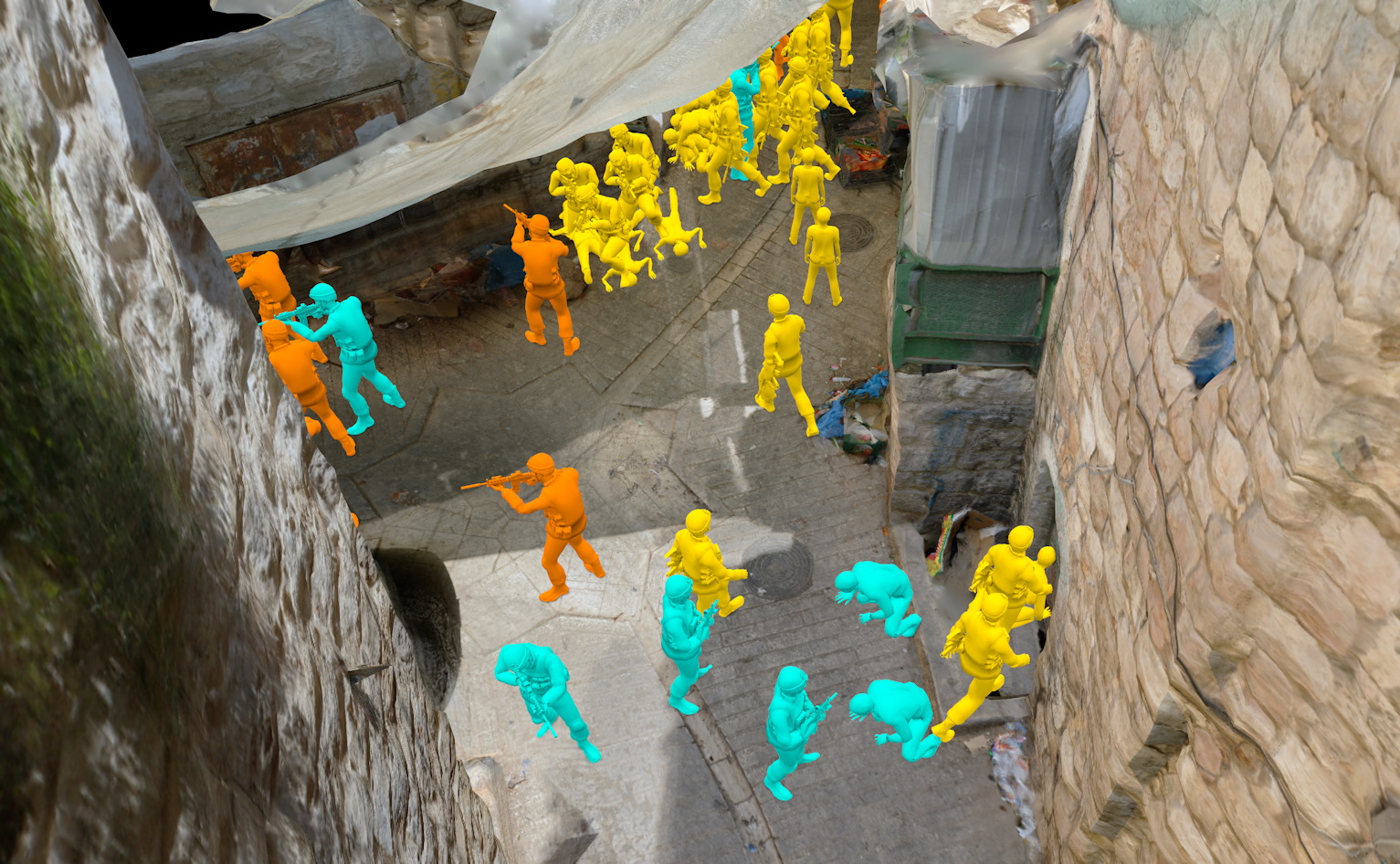
Boots on backs mean this not an advertisement for VR headsets or 3D modeling tools.

She cited a tongue-in-cheek definition of “mixed reality” referring to both digital crossover into the real world and the deliberate obfuscation of the truth at a greater scale.

“On the one hand you have mixing the digital world and the real, and on the other you have the mixed reality of the media environment, where there’s no agreement on reality and all these misinformation campaigns. What’s important about Forensic Architecture is they’re not just presenting evidence of the facts, but also the process used to arrive at these truth claims, and that’s extremely important.”

In openly presenting the means as well as the ends, Weizman and his team avoid succumbing to what he calls the “dark epistemology” of the present post-truth era.

“The arbitrary logic of the border”

As mentioned earlier, Weizman was denied entry to the U.S. for reasons unknown, but possibly related to the network of politically active people with whom he has associated for the sake of his work. Disturbingly, his wife and children were also stopped while entering the states a day before him and separated at the airport for questioning.

In a statement issued publicly afterwards, Weizman dissected the event.

In my interview the officer informed me that my authorization to travel had been revoked because the “algorithm” had identified a security threat. He said he did not know what had triggered the algorithm but suggested that it could be something I was involved in, people I am or was in contact with, places to which I had traveled… I was asked to supply the Embassy with additional information, including fifteen years of travel history, in particular where I had gone and who had paid for it. The officer said that Homeland Security’s investigators could assess my case more promptly if I supplied the names of anyone in my network whom I believed might have triggered the algorithm. I declined to provide this information.

This much we know: we are being electronically monitored for a set of connections – the network of associations, people, places, calls, and transactions – that make up our lives. Such network analysis poses many problems, some of which are well known. Working in human rights means being in contact with vulnerable communities, activists and experts, and being entrusted with sensitive information. These networks are the lifeline of any investigative work. I am alarmed that relations among our colleagues, stakeholders, and staff are being targeted by the US government as security threats.

This incident exemplifies – albeit in a far less intense manner and at a much less drastic scale – critical aspects of the “arbitrary logic of the border” that our exhibition seeks to expose. The racialized violations of the rights of migrants at the US southern border are of course much more serious and brutal than the procedural difficulties a UK national may experience, and these migrants have very limited avenues for accountability when contesting the violence of the US border.

The works being exhibited, he said, “seek to demonstrate that we can invert the forensic gaze and turn it against the actors—police, militaries, secret services, border agencies—that usually seek to monopolize information. But in employing the counter-forensic gaze one is also exposed to higher level monitoring by the very state agencies investigated.”

Forensic Architecture’s investigations are ongoing; you can keep up with them at the organization’s website. And if you’re in Miami, drop by MOAD to see some of the work firsthand.


from Gadgets – TechCrunch https://ift.tt/2PlmEDy
via IFTTT

Thursday, 23 January 2020

This ultrasonic gripper could let robots hold things without touching them

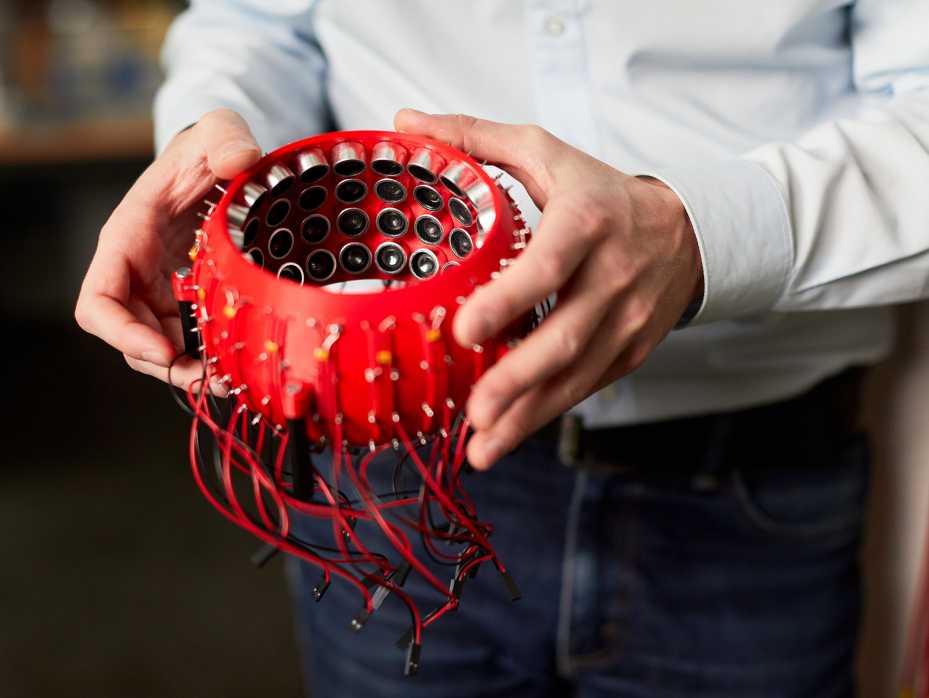
If robots are to help out in places like hospitals and phone repair shops, they’re going to need a light touch. And what’s lighter than not touching at all? Researchers have created a gripper that uses ultrasonics to suspend an object in midair, potentially making it suitable for the most delicate tasks.

It’s done with an array of tiny speakers that emit sound at very carefully controlled frequencies and volumes. These produce a sort of standing pressure wave that can hold an object up or, if the pressure is coming from multiple directions, hold it in place or move it around.

This kind of “acoustic levitation,” as it’s called, is not exactly new — we see it being used as a trick here and there, but so far there have been no obvious practical applications. Marcel Schuck and his team at ETH Zürich, however, show that a portable such device could easily find a place in processes where tiny objects must be very lightly held.

A small electric component, or a tiny oiled gear or bearing for a watch or micro-robot, for instance, would ideally be held without physical contact, since that contact could impart static or dirt to it. So even when robotic grippers are up to the task, they must be kept clean or isolated. Acoustic manipulation, however, would have significantly less possibility of contamination.

Another, more sinister-looking prototype.

The problem is that it isn’t obvious exactly what combination of frequencies and amplitudes are necessary to suspend a given object in the air. So a large part of this work was developing software that can easily be configured to work with a new object, or programmed to move it in a specific way — rotating, flipping, or otherwise moving it at the user’s behest.

A working prototype is complete, but Schuck plans to poll various industries to see whether and how such a device could be useful to them. Watchmaking is of course important in Switzerland, and the parts are both small and sensitive to touch. “Toothed gearwheels, for example, are first coated with lubricant, and then the thickness of this lubricant layer is measured. Even the faintest touch could damage the thin film of lubricant,” he points out in the ETHZ news release.

How would a watchmaker use such a robotic arm? How would a designer of microscopic robots, or a biochemist? The potential is clear but not necessarily obvious. Fortunately he has a bit of fellowship cash to spend on the question and hopes to spin it off as a startup next year if his early inquiries bear fruit.


from Gadgets – TechCrunch https://ift.tt/2RH0DPT
via IFTTT
Tuesday, 14 January 2020

Kids with lazy eye can be treated just by letting them watch TV on this special screen

Amblyopia, commonly called lazy eye, is a medical condition that adversely affects the eyesight of millions, but if caught early can be cured altogether — unfortunately this usually means months of wearing an eyepatch. NovaSight claims successful treatment with nothing more than an hour a day in front of its special display.

The condition amounts to when the two eyes aren’t synced up in their movements. Normally both eyes will focus the detail-oriented fovea part of the retina on whatever object the person is attending to; In those with amblyopia, one eye won’t target the fovea correctly and as a result the eyes don’t converge properly and vision suffers, and if not treated can lead to serious vision loss.

It can be detected early on in children, and treatment can be as simple as covering the good eye with a patch for most of the day, which forces the other eye to adjust and align itself properly. The problem is of course that this is uncomfortable and embarrassing for the kid, and of course only using one eye isn’t ideal for playing schoolyard games and other everyday things.

And you look cool doing it!

NovaSight’s innovation with CureSight is to let this alignment process happen without the eyepatch, instead selectively blurring content the child watches so that the affected eye has to do the work while the other takes a rest.

It accomplishes this with the same technology that, ironically, gave many of us double vision back in the early days of 3D: glasses with blue and red lenses.

Blue-red stereoscopy presents two slightly different versions of the same image, one tinted red and one tinted blue. Normally it would be used with slightly different parallax to produce a binocular 3D image — that’s what many of us saw in theaters or amusement park rides.

In this case, however, one of the two tinted images just has a blurry circle right where the kid is looking. The screen uses a built-in Tobii eye-tracking sensor so it knows where the circle should be; I got to test it out briefly and the circle quickly caught up with my gaze. This makes it so the other eye, affected by the condition but the only one with access to the details of the image, has to be relied on to point where the kid needs it to.

The best part is that there isn’t some treatment schema or tests — kids can literally just watch YouTube or a movie using the special setup, and they’re getting better, NovaSight claims. And it can be done at home on the kid’s schedule — always a plus.

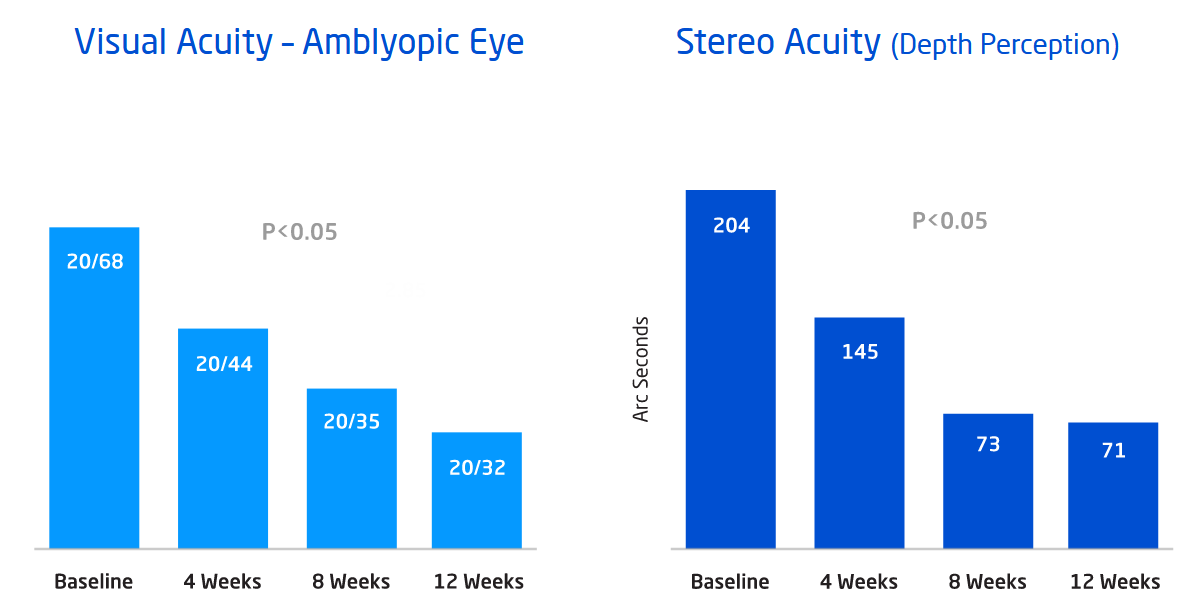
Graphs from NovaSight website.

The company has already done some limited clinical trials that showed “significant improvement” over a 12-week period. Whether it can be relied on to completely cure the condition or if it should be paired with other established treatments will come out in further trials the company has planned.

In the meantime, however, it’s nice to see a technology like 3D displays applied to improving vision rather than promoting bad films. NovaSight has been developing and promoting its tech over the last year; It also has a product that helps diagnose vision problems using a similar application of 3D display tech. You can learn more or request additional info at its website.


from Gadgets – TechCrunch https://ift.tt/2Rdhutx
via IFTTT

Tuesday, 3 December 2019

‘Carpentry Compiler’ turns 3D models to instructions on how to build them

Even to an experienced carpenter, it may not be obvious what the best way is to build a structure they’ve designed. A new digital tool, Carpentry Compiler, provides a way forward, converting the shapes of the structure to a step-by-step guide on how to produce them. It could help your next carpentry project get off the screen and into the shop.

“If you think of both design and fabrication as programs, you can use methods from programming languages to solve problems in carpentry, which is really cool,” said project lead Adriana Schulz from the University of Washington’s computer science department, in a news release.

It sounds a bit detached from the sawdust and sweat of hands-on woodworking, but they don’t say “measure twice, cut once” for nothing. Carpentry is a cerebral process more than a physical one, and smart, efficient solutions tend to replace ones that are merely well made.

What Carpentry Compiler does is codify the rules that govern design and carpentry, for example what materials are available, what tools can do, and so on, and use those to create a solution (in terms of cuts and joins) to a problem (how to turn boards into a treehouse).

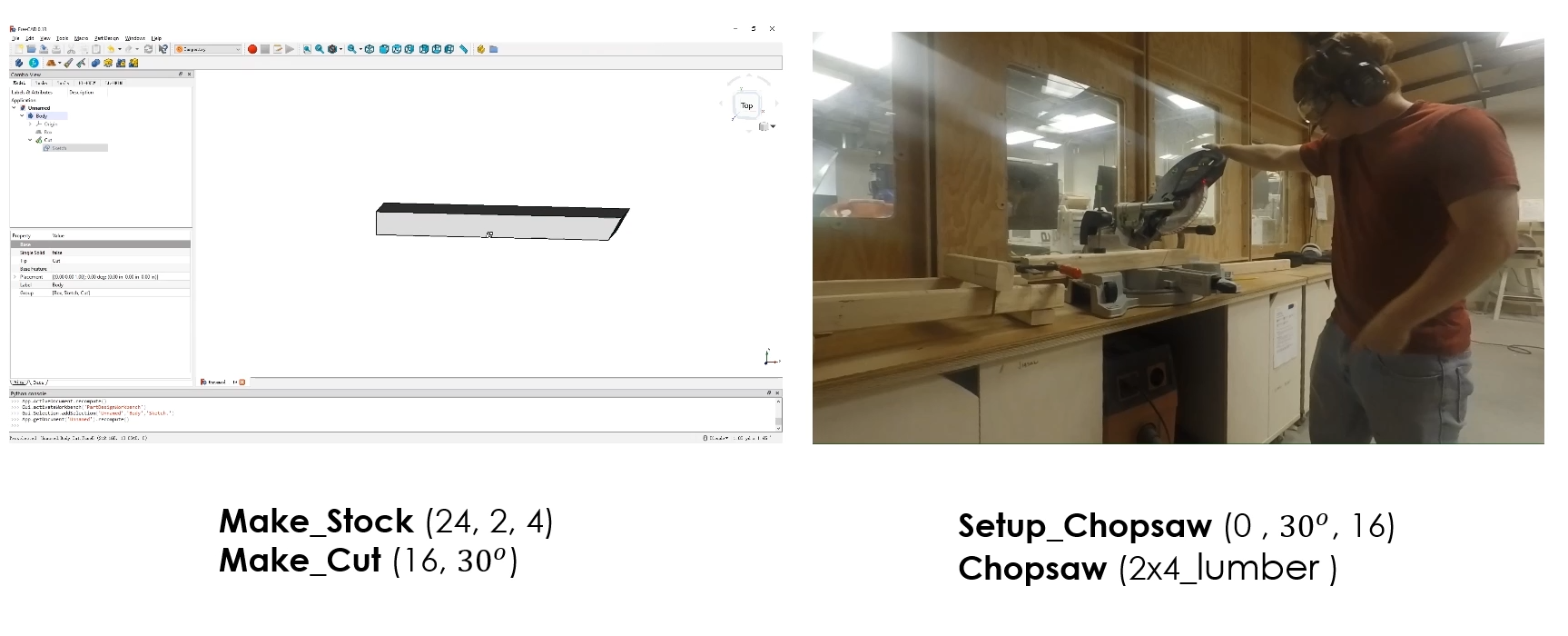
Users design in a familiar 3D model interface, as many already do, creating the desired structure out of various shapes that they can modify, divide, pierce, attach, and so on. The program then takes those shapes and determines the best way to create them from your existing stock, with the tools you have — which you can select from a list.

Need to make the roof of your treehouse but only have 2x4s? It’ll provide a recipe with that restriction. Got some plywood sheets? It’ll use those, and the leftovers contribute to the base so there’s less waste. By evaluating lots and lots of variations on how this might be accomplished, the program arrives at what it believes are the best options, and presents multiple solutions.

“If you want to make a bookcase, it will give you multiple plans to make it,” said Schulz. “One might use less material. Another one might be more precise because it uses a more precise tool. And a third one is faster, but it uses more material. All these plans make the same bookcase, but they are not identical in terms of cost. These are examples of tradeoffs that a designer could explore.”

A 24-inch 2×4 gets cut at 16 inches at a 30-degree angle.

That’s really the same kind of thing that goes on inside a woodworker’s brain: I could use that fresh sheet to make this part, and it would be easy, or I could cut those shapes from either corner and it would leave room in the middle, but that’ll be kind of a pain… That sort of thing. It can also optimize for spatial elements, if for example you wanted to pack the parts in a box, or for cost if you wanted to shave a few bucks off the project.

Eventually the user is provided with a set of instructions specific to their set of tools. And the carpenters themselves act as the “processor,” executing operations, like “cut at this angle,” on real-world materials. In Carpenter Compiler, computer programs you!

The team presented their work at SIGGRAPH Asia last month. You can read more about the project (and learn how you can try it yourself) at its webpage.


from Gadgets – TechCrunch https://ift.tt/2sG2AmX
via IFTTT

Thursday, 10 October 2019

Creators of modern rechargeable batteries share Nobel prize

If you had to slip a couple AAs into your smartphone every morning to check your email, browse Instagram, and text your friends, chances are the mobile revolution would not have been quite so revolutionary. Fortunately the rechargeable lithium-ion battery was invented — a decades-long task for which three men have just been awarded the Nobel Prize in Chemistry.

The prize this year honors M. Stanley Whittingham, John Goodenough, and Akira Yoshino, all of whom contributed to the development of what is today the most common form of portable power. Without them (and of course those they worked with, and those who came before) we would be tied to even more wasteful and/or stationary sources of energy.

Lead-acid batteries had been in use for nearly a century by the time people really got to thinking about taking things to the next level with lithium, a lightweight metal with desirable electrical properties. But lithium is also highly reactive with air and water, making finding suitable substances to pair it with difficult.

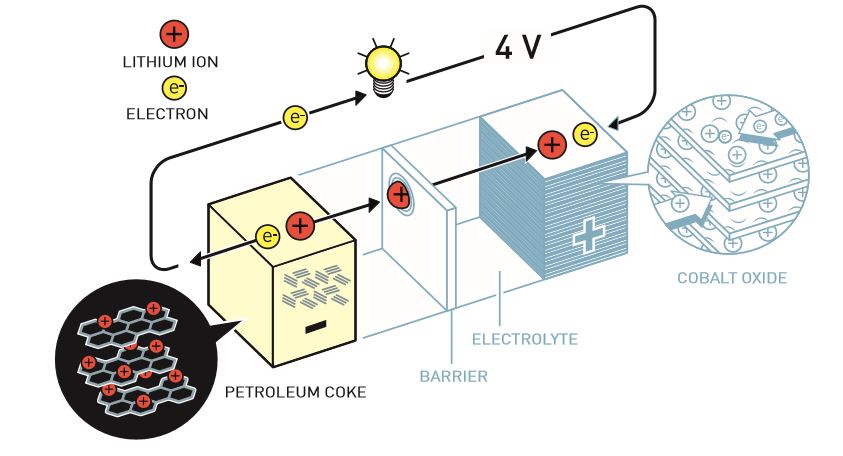
Experiments in the ’50s and ’60s laid the groundwork for more targeted investigations, in particular Whittingham’s. He and partner Fred Gamble showed in 1976 that lithium ions, after donating electrons to produce a charge, fit perfectly into a lattice of titanium disulfide — where they sit patiently (in their “van der Waals gaps”) until an electron is provided during recharging. Unfortunately this design also used a lithium anode that could be highly reactive (think fire) if bent or crushed.

John Goodenough and his team soon developed a better cathode material (where the lithium ions rested) with a much higher potential — more power could be drawn, opening new possibilities for applications. This, combined with the fact that the metallic lithium anodes could be highly reactive (think fire) if bent or crushed, led to increased research on making batteries safe as well as useful.

yoshino battery

In 1985 research by Akira Yoshino led to the discovery of several materials (whose names won’t mean anything to anyone without domain knowledge) that could perform as well while also being able to be physically damaged and not cause any major trouble.

Many, many improvements have been made since then, but the essentials of the technology were laid out by these teams. And soon after lithium-ion batteries were shown to be safe, capacious, and able to be recharged hundreds of times, they were found in laptops, medical devices, and eventually mobile phones. Today, after three more decades of enhancements, lithium batteries are now taking on gasoline as the energy storage medium of choice for human transportation.

The three scholars whose work most powerfully advanced this technology from theory to commercial reality were awarded equal shares of this year’s Nobel Prize in Chemistry, each taking home a third of the million and, more importantly, the distinction of being recognized in historic fashion.


from Gadgets – TechCrunch https://ift.tt/2p3FUeC
via IFTTT
Thursday, 3 October 2019

MyMilk Labs launches Mylee, a small sensor that analyzes breast milk at home

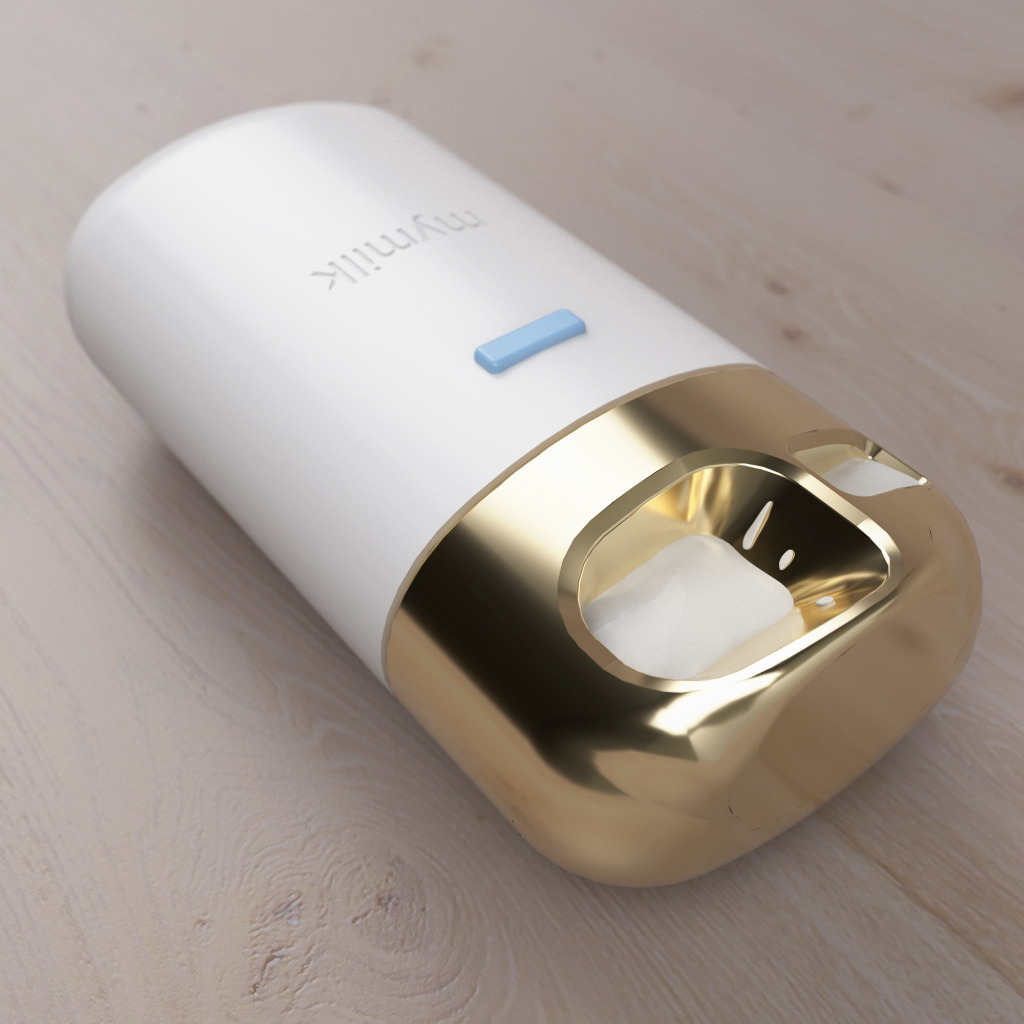
Many expectant mothers are told that breastfeeding will come naturally, but it is often a fraught and confusing experience, especially during the first few weeks after birth. Parents often worry about if their babies are getting enough nutrition or if they are producing enough milk. MyMilk Labs wants to give nursing mothers more information with Mylee, a sensor that scans a few drops of breast milk to get information about its composition and connects to a mobile app. The Israel-based company presented today at Disrupt Battlefield as one of two wild card competitors picked from Startup Alley.

The Mylee launched at Disrupt with a pre-order price of $249 (its regular retail price is $349). Based in Israel, MyMilk Labs was founded in 2014 by Ravid Schecter and Sharon Haramati, who met while working on PhDs in neuroimmunology and neurobiology, respectively, at the Weizmann Institute of Science.

Mylee deviceDuring the company’s stage presentation, Schecter said the device is meant to give mothers and lactation consultants objective information about breast milk.

Breast milk changes in the first days and weeks after birth, progressing from colostrum to mature milk. Mylee scans the electrochemical properties of milk and then correlates that to data points based on MyMilk Labs’ research to calculate where the sample is on the continuum, then tells mothers if their milk is “delayed” or “advanced,” relative to the time that has passed since they gave birth.

The device’s first version is currently in a beta pilot with lactation consultants who have used them to scan milk samples from 500 mothers.

MyMilk Labs already has consumer breast milk testing kits that enable mothers to provide a small sample at home that is then sent to MyMilk Labs’ laboratories for analysis. One is a nutritional panel that gives information about the milk’s levels of vitamins B6, B12 and A, calories and fat percentage, along with dietary recommendations for the mother. Another panel focuses on what is causing breast pain, a frequent complaint for nursing mothers. It tests for bacterial or fungal infections and gives antibiotic suggestions depending on what strains are detected.

Though some doctors believe testing kits are unnecessary for the majority of nursing mothers, there is demand for more knowledge about breastfeeding, as demonstrated by the line-up of breast milk testing kits from MyMilk Labs and competitors like Lactation Labs, Everly Well and Happy Vitals. Haramati said on stage that MyMilk Labs plans to eventually transfer some of the tests’ capabilities to the Mylee.


from Gadgets – TechCrunch https://ift.tt/2n3i8P1
via IFTTT