Thursday, 26 December 2013

Tegra Note 7 gets updated with Android 4.3 and camera enhancements

Gogolook Confirms Its Acquisition By Naver, The Owner Of Line

Taipei-based startup Gogolook confirmed that it has been acquired by Naver, the Korean Internet giant that is best known outside of Asia for being the owner of Line. Gogolook has not disclosed the acquisition price, but a report yesterday from the Investment Commission of Taiwan’s Ministry of Economic Affairs said the amount was NT$529 million (or about $17.6 million USD) (h/t Tech In Asia). In an email, Gogolook CEO Jeff Kuo told me:
“After joining the Naver group, Gogolook will be able to accelerate and extend our strategic business deployment in a global scope. With the affiliation of LINE and abundant resources from the parent company worldwide, we cannot wait to show the world the strong innovative capabilities of Taiwan app startups.”
Gogolook’s flagship product is Whoscall, a caller ID app that has 1.2 million monthly active users and over 600 million numbers in its database, according to the company. We profiled Gogolook in June when the company launched the iOS version of Whoscall. Gogolook was officially launched in April 2012, but started three years earlier as a side project by three friends, including founders Kuo and Edgar Chiu. Whocall’s database of numbers was originally gathered from public sources like the Yellow Pages and the Google Place API, but as the app’s user base grew, it began to rely on crowd-sourcing. The company’s database of numbers–including spam callers–might prove handy to Naver as it seeks to build Line’s global footprint and compete against other popular messaging apps like WeChat and WhatsApp.
Gogolook raised about $500,000 in angel funding and its investors included Trinity VC.

via TechCrunch » Startups http://feedproxy.google.com/~r/techcrunch/startups/~3/19r20Rwl1Ws/
Code.org: 2 Weeks And 600M+ Lines Of Code Later, 20M Students Have Learned An “Hour Of Code”
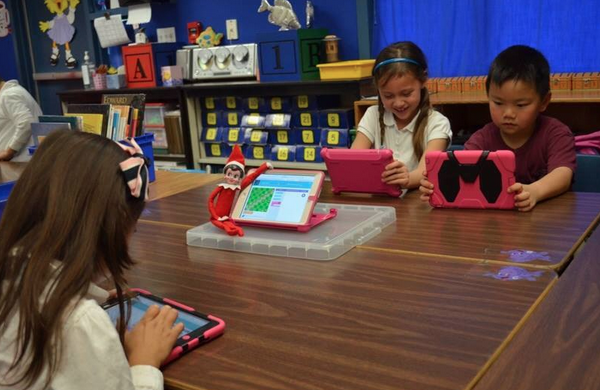
Less than a year ago, brothers Hadi Partovi and Ali Partovi launched Code.org to help advocate for computer science in the U.S. and increase participation in STEM education by making these subjects more available in schools and classrooms around the country. Today, it seems that what started as a whisper has grown into a roar.
On December 9th, Code.org kicked off a new, nationwide campaign called the “Hour of Code,” which asked teachers across the U.S. to help introduce their students to the basics of computer science through the organization’s coding programs and tutorials. Timed in conjunction with Computer Science Education Week, the campaign has sought to change the perception of Computer Science in the American education system — chief of which is the fact that, today, 9 out of 10 schools in the U.S. do not offer Computer Science classes.
After months campaigning and lobbying for change at the state level, in which the Partovis and Code.org have asked states to begin offering programming classes for credit, it seems that their work has begun to pay off — both at the policy level and through the “Hour of Code.” Alabama, Maryland and Wisconsin have announced (or are planning to announce) policy changes at the state level, while both the Chicago Public Schools and the New York City Department of Education have unveiled plans to bring computer science to their classrooms.
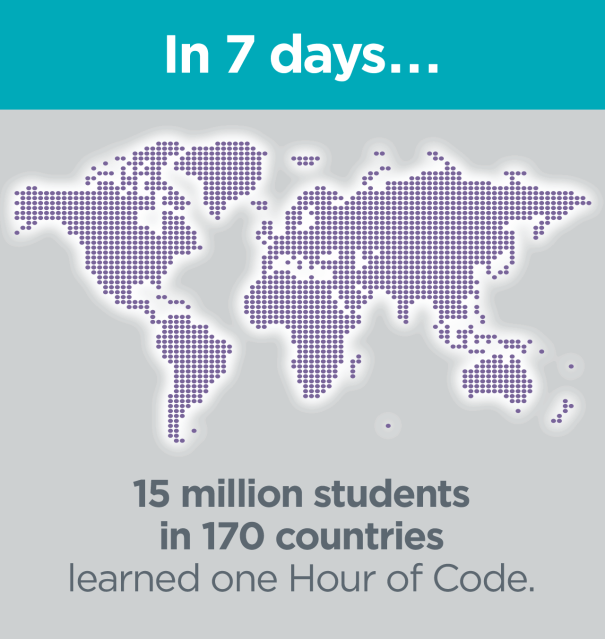
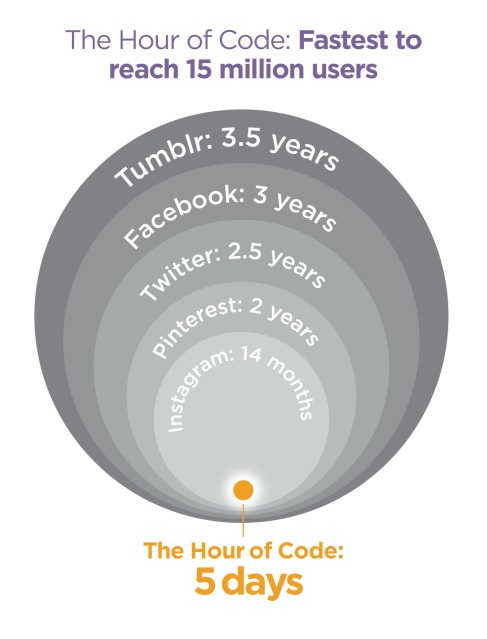
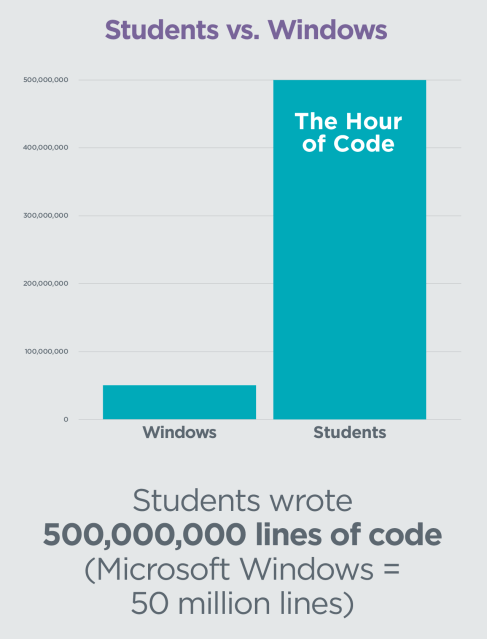
What’s more, at the culmination of Computer Science Education Week, the Partovis told us that more than 15 million students had participated in the “Hour of Code,” collectively writing more than 500 million lines of code during the campaign. While Computer Science Education Week came to a close on December 16th, the campaign has continued, and the number of students participating has since crossed 20 million, with over 675 million lines of code now in the books.
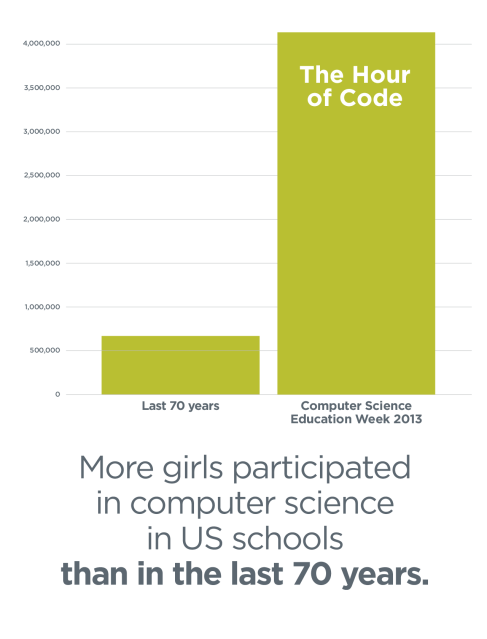
All told, Hadi Partovi told TechCrunch, more than 20 million students have participated across 170 countries. However, factoring out non-U.S. students and adults, Code.org claims that just about 1 in 4 students in K-12 schools in the U.S. participated in the “Hour of Code.” What’s more, Partovi tells us that “more girls participated in computer science in participating schools in the last two weeks than all students in the history of U.S. public schools combined.”
To breakdown the “Hour of Code” stats even further, Code.org tells us that, of the 20 million-plus participating, 83 percent were from the U.S., 74 percent were in grades K-12, 51 percent were girls, 8 percent were African-American and 14 percent were Hispanic. While we’d all no doubt like to see these percentages continue to rise and it remains to be seen just how much of a long-term effect one hour of programming can have on students, the “Hour of Code” is off to an impressive start.
As to how the campaign has managed to accomplish this?
The “Hour of Code” has been bolstered by support from a litany of recognizable names. For starters, as we wrote at the outset, both Microsoft and Apple showed their support by hosting an “Hour of Code” at every one of their retail outlets over the course of the week, with Apple advertising its tutorial on its homepage. Google, in turn, kicked off of Computer Science Education Week with a Google Doodle that remembered “Grace Hopper, an American computer scientist and creator of the Cobol programming language,” and also linked to “Hour of Code” beneath the dootle.
On top of that, the campaign featured on the home pages of YouTube, MSN, Bing, Yahoo, Disney (and many more), with recognizable names from across politics, music and sports pitching in their support. Among them were “actors and musicians like Shakira, Ashton Kutcher, Angela Bassett and athletes like Chris Bosh, Warren Sapp and Dwight Howard, along with tech leaders like Steve Jobs, Bill Gates, Mark Zuckerberg and Susan Wojcicki.”
Politicians from both sides of the aisle also lent their support, including President Obama and House Majority Leader Eric Cantor, as well as “Senator Cory Booker, Newt Gingrich and Secretary of Education Arnie Duncan.”
To help teachers get their students started in the world of programming, Code.org has curated online tutorials and programs from a bevy of partners, including companies, non-profits and universities. The traffic to some of its partners was so heavy, particularly Khan Academy, that their website was forced offline — as ATD reported at the time.
So far, it’s been a strong showing, but the 20 million is just a start. To find more on how to participate, find the “Hour of Code” at home here. You can also find the videos from President Obama and more in our previous coverage here and more info in the infographic below.

via TechCrunch » Startups http://feedproxy.google.com/~r/techcrunch/startups/~3/Jjn8494vsTY/
Digitally simulated worm wriggles for the first time (video)

Películas clásicas para disfrutar en streaming, cortesía del dominio público
Eduardo nos cuenta que ha dedicado bastante tiempo a crear y hacer crecer Public Domain Movies , un blog dedicado a recopilar películas clásicas que son del dominio público. (Todas en inglés porque es prácticamente conseguir dominio público en castellano.)
La historia es interesante porque parte de la premisa de que en la películas muy, muy antiguas llega un momento en que expiran los derechos de autor –por plazos o porque simplemente mueren– pasando a ser del dominio público. Esto varía según las legislaciones, pero en la mayoría de los países este plazo está entre 50 o 100 años; en España concretamente son 70. A partir de ese momento cualquiera puede copiarlas y redistribuirlas.
Gracias a esta particularidad de la ley se pueden disfrutar de forma libre y gratuita clásicos como las películas de Chaplin, los primeros largometrajes de Hitchcock o ese engendro de culto llamado Plan 9 from Outer Space (en el que se basó Ed Wood). De hecho no son pocos los canales de TV donde predominan las películas muy viejunas simplemente por esta razón: porque no pagan derechos.
Pero otros casos a los que ha llegado el «dominio público» son más peculiares: La noche de los muertos vivientes (1968), que podría considerarse el origen de todas las películas de zombies modernos, perdió su copyright en una rocambolesca historia por olvidar incluir el símbolo «©» junto a los títulos de crédito.
Respecto a Public Domain Movies, su creador nos ha contado que ha pasado por varias etapas, una historia también interesante: aunque las películas están el dominio público, Google le ha cerrado el canal de YouTube alguna vez, ante lo que solo ha podido recurrir justificando y explicando el proyecto y su estado legal. También ha de pelearse habitualmente con los «trolls del copyright» que reclaman derechos sobre películas que en realidad son del dominio público (!) Su solución ha sido subir todas las películas a un canal específico que ya ha adquirido cierta reputación, y donde no hay publicidad ni AdSense, para evitar todos esos problemas absurdos.
via Microsiervos http://www.microsiervos.com/archivo/peliculas-tv/peliculas-clasicas-dominio-publico.html